Whether or not your local high school offers advanced STEM courses depends quite a bit on where the school is located.
A new research paper by University of Tennessee professor Kelly Boles analyzed AP course offerings* at more than 21,000 public high schools from 2015-2019. Boles divided the schools into four geographic group types: city, suburban, town, and rural. Overall, more than 62% of American high schools offered at least one AP STEM course. But that average masks some enormous geographic differences.
About 79% of suburban schools offered at least one AP STEM course. That figure was lower in cities and towns, and more than half of rural high schools didn’t offer a single AP STEM course.
The gap was even wider at the upper end. Nearly six in ten suburban schools offered five or more AP STEM courses. These are schools that were offering a wide variety of STEM classes.
Meanwhile, less than one-quarter of schools in towns made the same variety available, and just 16% of rural schools offered five or more AP STEM courses.
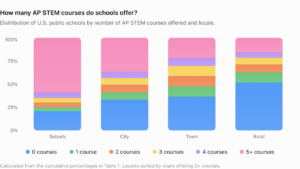
In other words, the distributions were almost mirror images. A suburban school was nearly three times as likely to offer five or more AP STEM courses as it was to offer none. A rural school was more than three times as likely to offer zero as it was to offer five or more.
From a student’s perspective, it’s nice to have access to an advanced course, but it’s much better to have a variety of options. A student interested in engineering might want to take calculus and physics, while another student might prefer computer science or biology. Boles’ paper finds particularly large geographic gaps in terms of access to this variety of choices.
Some of this reflects school size. Smaller schools have fewer students to spread the costs of specialized teachers and classes, and rural schools tend to be smaller. Boles finds that school size explained a portion of the geographic differences. But it didn’t explain everything. Even after accounting for enrollment and other school characteristics, rural and town schools offered a smaller variety of AP STEM courses than suburban schools.
In short, students in rural areas have limited access to AP STEM courses, while many students in suburban schools are presented with a full menu of options.
Some of that gap may be unavoidable. A small rural high school can’t reasonably employ a teacher for every specialized STEM course that a large suburban school can offer. But that doesn’t mean students’ opportunities should stop at the boundaries of their local school.
States should make it easier for students to access advanced courses elsewhere. That could mean high-quality virtual classes, allowing students to take individual courses from neighboring school districts, regional course-sharing arrangements, or dual enrollment with the closest colleges nearby. The goal shouldn’t necessarily be for every high school to offer every course. It should be for every qualified student to have access to the courses they’re ready to take.
This is also worth remembering as more states and districts try to identify students who are ready for advanced math at younger ages. One potential argument against automatically enrolling qualified middle schoolers in Algebra I is that students in small or rural districts may eventually exhaust their local math offerings. That’s a real problem, but it’s an argument for expanding what comes next, not for slowing students down. School systems shouldn’t hold an eighth grader back from algebra because she might run out of math classes four years later. They should make sure she has somewhere to go when she gets there.
*Boles counted whether the school offered a course in AP Biology, AP Calculus AB, AP Calculus BC, AP Chemistry, AP Computer Science A, AP Computer Science Principles, AP Environmental Science, AP Physics 1: Algebra-Based, AP Physics 2: Algebra-Based, AP Physics C: Electricity and Magnetism, AP Physics C: Mechanics, and AP Statistics.

Where You Live Shapes Your AP STEM Options
Whether or not your local high school offers advanced STEM courses depends quite a bit on where the school is located.
A new research paper by University of Tennessee professor Kelly Boles analyzed AP course offerings* at more than 21,000 public high schools from 2015-2019. Boles divided the schools into four geographic group types: city, suburban, town, and rural. Overall, more than 62% of American high schools offered at least one AP STEM course. But that average masks some enormous geographic differences.
About 79% of suburban schools offered at least one AP STEM course. That figure was lower in cities and towns, and more than half of rural high schools didn’t offer a single AP STEM course.
The gap was even wider at the upper end. Nearly six in ten suburban schools offered five or more AP STEM courses. These are schools that were offering a wide variety of STEM classes.
Meanwhile, less than one-quarter of schools in towns made the same variety available, and just 16% of rural schools offered five or more AP STEM courses.
In other words, the distributions were almost mirror images. A suburban school was nearly three times as likely to offer five or more AP STEM courses as it was to offer none. A rural school was more than three times as likely to offer zero as it was to offer five or more.
From a student’s perspective, it’s nice to have access to an advanced course, but it’s much better to have a variety of options. A student interested in engineering might want to take calculus and physics, while another student might prefer computer science or biology. Boles’ paper finds particularly large geographic gaps in terms of access to this variety of choices.
Some of this reflects school size. Smaller schools have fewer students to spread the costs of specialized teachers and classes, and rural schools tend to be smaller. Boles finds that school size explained a portion of the geographic differences. But it didn’t explain everything. Even after accounting for enrollment and other school characteristics, rural and town schools offered a smaller variety of AP STEM courses than suburban schools.
In short, students in rural areas have limited access to AP STEM courses, while many students in suburban schools are presented with a full menu of options.
Some of that gap may be unavoidable. A small rural high school can’t reasonably employ a teacher for every specialized STEM course that a large suburban school can offer. But that doesn’t mean students’ opportunities should stop at the boundaries of their local school.
States should make it easier for students to access advanced courses elsewhere. That could mean high-quality virtual classes, allowing students to take individual courses from neighboring school districts, regional course-sharing arrangements, or dual enrollment with the closest colleges nearby. The goal shouldn’t necessarily be for every high school to offer every course. It should be for every qualified student to have access to the courses they’re ready to take.
This is also worth remembering as more states and districts try to identify students who are ready for advanced math at younger ages. One potential argument against automatically enrolling qualified middle schoolers in Algebra I is that students in small or rural districts may eventually exhaust their local math offerings. That’s a real problem, but it’s an argument for expanding what comes next, not for slowing students down. School systems shouldn’t hold an eighth grader back from algebra because she might run out of math classes four years later. They should make sure she has somewhere to go when she gets there.
*Boles counted whether the school offered a course in AP Biology, AP Calculus AB, AP Calculus BC, AP Chemistry, AP Computer Science A, AP Computer Science Principles, AP Environmental Science, AP Physics 1: Algebra-Based, AP Physics 2: Algebra-Based, AP Physics C: Electricity and Magnetism, AP Physics C: Mechanics, and AP Statistics.
Chad Aldeman
Recent posts
A Low-Cost, Highly Effective Math Program
Let the March Mathness Begin
Automatic Enrollment Policies Check All the Boxes
Virginia Pushes to Accelerate Students in Math