
Early numeracy has no national guidance. It should.
Join governors, researchers, educators, and pediatric professionals calling on the American Academy of Pediatrics and the U.S. Surgeon General to give families guidance on early math — the everyday counting, comparing, and game-playing that millions of families already do.
Lead Signatories
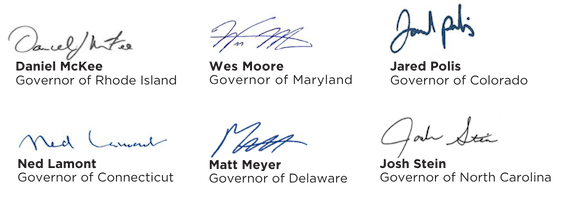
Governors
Researchers, Educators, and Clinicians
Dr. Arun Ramanathan
CEO, PowerMyLearning
Dr. Deborah Stipek
Professor Emerita
DREME Network Faculty Director
Stanford University
Dr. Natasha Gerstenschlager Wilson
Director of Learning Sciences, HMH
Holly Kreider
Director of Family Math, NAFSCE’s Center for Family Math
Michelle Torgerson
President and CEO, Raising A Reader
Joleigh Honey
Co-Founder, Math for the Future
Mathematical Sciences Education Board, National Academies
Dr. Ted Coe
Co-Founder, Math for the Future
Executive Committee,
Conference Board of the Mathematical Sciences
Michèle M. Mazzocco
Professor, Institute of Child Development,
University of Minnesota
Robert C. Pianta, Ph.D.
Batten Bicentennial Professor of Education Emeritus
Dean Emeritus, School of Education and Human Development
University of Virginia
Kristin Umland
CEO & Cofounder
Illustrative Mathematics
Eric Dearing
Executive Director,
Mary E. Walsh Center for Thriving Children
Autumn Rivera
2022 Colorado Teacher of the Year
Rebecka Peterson
2023 National Teacher of the Year
Chelsea Barbercheck
KC STEM Alliance
Bibb Hubbard
Founder & CEO,
Learning Heroes
Susan C. Levine
Rebecca Anne Boylan Distinguished Service Professor in Education and Society,
University of Chicago
Nicole M. McNeil
Professor of Psychology
Director, Cognition Learning and Development Lab
University of Notre Dame
Milissa O’Neil
2025 Rhode Island Teacher of the Year
Robert Sege, MD, PhD
Center for Community-Engaged Medicine
Tufts Medical Center
Vanessa Vakharia
Founder & CEO,
The Math Guru
Joshua L. Michael, Ph.D.
Executive Director
Sherman Family Foundation
Eboney McKinney
President
Association of State Supervisors of Mathematics
Latrenda Knighten
President
National Council of Teachers of Mathematics
Dr. Chris Wright
CEO, Early Family Math
Keri Rodrigues
President, National Parents Union
Dr. Pamela Cantor, MD
Co-Founder / CEO,
The Human Potential L.A.B.
Hear From a Leading Educator
“When families learn from a trusted source like a pediatrician that small, consistent habits — 20 minutes with a deck of cards, a board game on a Friday night — are building the numeracy intuition their children will draw on through every science class, every career pathway and every data-driven decision they’ll ever face, they stop seeing math as someone else’s subject.”

FAQ
What is this petition actually asking for?
That the American Academy of Pediatrics adopt formal guidance on early math play — a specific, weekly recommendation for young children, the way it already recommends reading aloud daily. Or that the U.S. Surgeon General issue a recommendation encouraging the same. We are not asking either body to endorse a product, a curriculum, or a company.
Does every kind of game support early math? What sort of games is the campaign suggesting?
The games that build early math are the ones where a child engaged in numeracy-based thinking: counting spaces, comparing quantities, matching and sorting, spotting a pattern, sequencing, judging what’s likely, or thinking a move ahead. A game of Uno or Yahtzee or a simple card game does this, as may more complex board, card, or active games. We are not endorsing specific titles or brands — we are asking the experts to define what qualifies, which is exactly the kind of judgment pediatric guidance is built to make.
Do I need to buy anything?
No. A deck of cards, a pair of dice, a handful of coins, or the games already in the closet will do it. Cost is not the barrier here — nobody has told families this play counts.
Is there evidence behind this?
Yes. Research on early math has consistently found that children’s math skills at kindergarten entry are among the strongest predictors of later academic outcomes, and that everyday math talk and play at home is associated with stronger early math development.
Isn't math the school's job?
Schools carry a lot. But the foundation is set before a child ever enters a classroom, and that’s precisely why pediatricians already talk to parents about reading. The well-child visit is one of the few moments where nearly every family, regardless of income or zip code, gets direct guidance about their child’s development. Right now that guidance covers reading and says nothing about math.
Is this one more thing for parents to feel guilty about?
No. Nobody has told parents that early math play matters, or what it looks like, or how much of it to do. That’s not a failure of parenting. It’s a gap in the guidance families get. Reading guidance worked because it was clear and easy to act on: read together, every day, starting early. Early math deserves the same — something any family can pick up with a deck of cards and ten minutes, without buying anything and without having to be an educator by trade.
Does screen time count? What about math apps?
That’s a question for the experts, not for us. Our ask is that the AAP and the Surgeon General define what qualifies — including where digital play fits. We are not asking them to bless screens, and we are not asking them to rule them out.
Does this compete with reading?
No. Daily reading guidance is a success story, and it’s the model we’re pointing to. Children need both. The point is that one of them has a national habit built around it and the other doesn’t.
Who is behind this, and what happens after I sign?
We’re All Solvers is a campaign of the Collaborative for Student Success, a national nonprofit working on K-12 education policy. Six governors have signed the letter to the AAP and the Surgeon General. Signatures gathered here will be added to that record and delivered as part of the campaign’s outreach, and we’ll email you with updates on where it goes.