
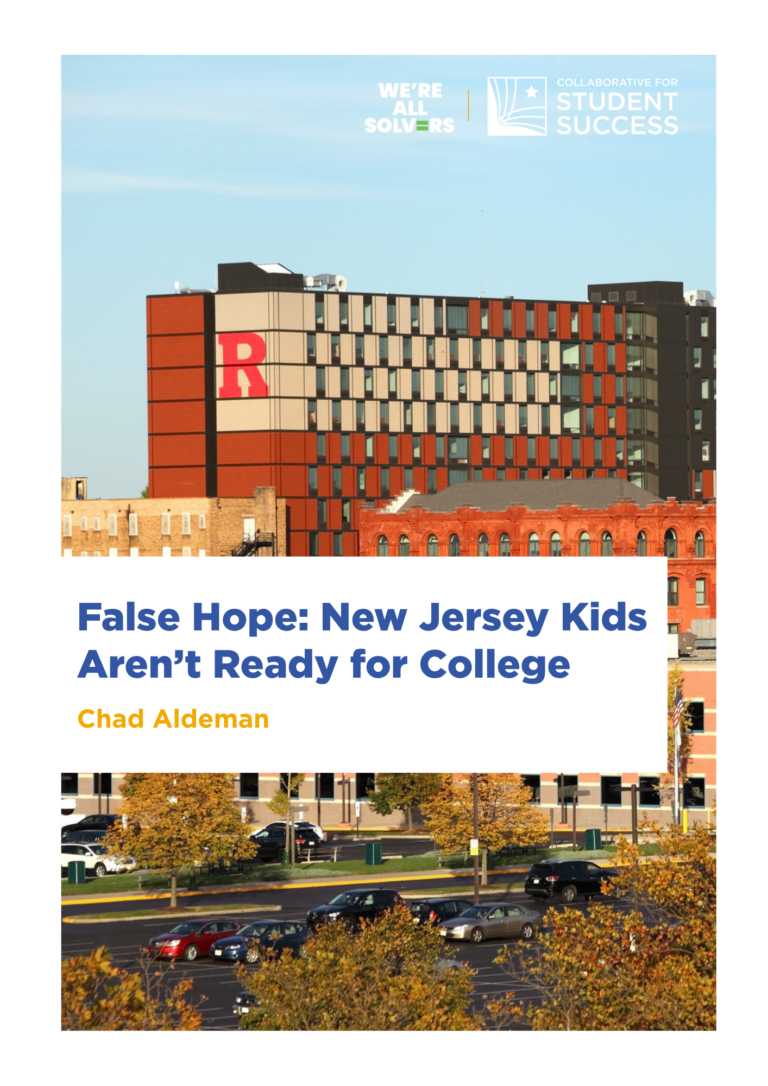
New Jersey's high school graduation rate just hit a record high. Its students' readiness for college math didn't follow, with a 30+ point gap between the grad rate and math proficiency. A new report tracks what happens when the two diverge — starting with the freshmen arriving at Rutgers.
By Chad Aldeman, published in partnership with We're All Solvers and the Collaborative for Student Success
The report recommends:
Setting one honest, fixed benchmark instead of a menu of alternative tests with lower bars.
Reporting state test results faster. New Jersey families often don’t see results until October; states like Ohio and Virginia require results by June 30.
Addressing gaps starting in third grade, when they are already highly predictive of high school outcomes.
Creating a genuinely “college-ready” diploma track, paired with guaranteed placement into college-level courses at any NJ public college or university.
At-a-Glance

New Jersey’s record-high Class of 2025 graduation rate
of 11th graders met the math requirement through the state graduation test
1/3
Incoming Rutgers freshmen placed below Calculus in 2025
440 vs. 530
New Jersey’s SAT math score for a diploma vs. SAT’s college-ready benchmark.
What the Data Show
Every incoming Rutgers freshman without AP or transfer credit takes a math placement exam before their first class. In 2025, nearly a third placed below Calculus — up seven percentage points from 2019, including a near-doubling of students needing Elementary or Intermediate Algebra, material New Jersey law already requires for a high school diploma.
New Jersey allows students to satisfy the math graduation requirement with a 17 on the ACT; ACT’s own research sets the college-ready benchmark at 22. Portfolio appeals, a subjective non-test pathway, accounted for 15% of 2022 graduates, nearly double the 2018 share.
Community college remediation data tracked since 2009 by Yvonne Greenbaun, president of the NJ Association of Mathematics Teacher Educators, shows remediation rates falling over the same period that underlying math skills have declined statewide.
What Faculty Are Seeing
Rutgers faculty describe a recurring pattern: students arrive with strong high school transcripts and place below Calculus anyway.

“They got A’s and B’s in high school,” and they believe “their high school grades reflect their abilities.”
— Steve Safran, Associate Professor of Mathematics, Rutgers
“Many of the students who come into pre-calculus feel like they shouldn’t be there. They feel disappointed in themselves.”
— Sally Mulvey, Lecturer, Rutgers Department of Mathematics
What Should Change
Over the past decade, New Jersey has added alternative pathways to its math graduation requirement, including substitute test scores set below college-ready levels and subjective portfolio reviews. In 2023, the State Board voted 6–5 to lower the passing score on its own test further.

The report recommends:
Setting one honest, fixed benchmark instead of a menu of alternative tests with lower bars.
Reporting state test results faster. New Jersey families often don’t see results until October; states like Ohio and Virginia require results by June 30.
Addressing gaps starting in third grade, when they are already highly predictive of high school outcomes.
Creating a genuinely “college-ready” diploma track, paired with guaranteed placement into college-level courses at any NJ public college or university.
About the Report
Chad Aldeman is a national K-12 and higher education researcher who has worked at the Edunomics Lab at Georgetown University, Bellwether Education, and the U.S. Department of Education. This report is based on Rutgers placement data and interviews with Rutgers math faculty, advisors, and department chairs, along with community college faculty across New Jersey. It was commissioned by the Collaborative for Student Success as part of the We’re All Solvers campaign.