
State leadership can reshape the culture around math — and unlock opportunity for the next generation of problem solvers.
Why This Matters?
Math achievement is not just an education issue — it is an economic competitiveness issue.
The latest national assessment results show persistent declines in math performance. At the same time, research continues to demonstrate that early math proficiency is strongly tied to long-term earnings and workforce participation across industries.
Yet too often, math is treated as optional, or even worse, culturally acceptable to struggle with.
As chief executives of your states, governors are uniquely positioned to shift this narrative. Elevating math achievement strengthens workforce pipelines, fuels innovation, and signals that problem-solving is foundational to your state’s future prosperity.
This is about restoring urgency, coherence, and cultural clarity around math.
The Governors' Commitment
Setting the Signal in Your State
Governors shape priorities — not just through policy, but through signal.
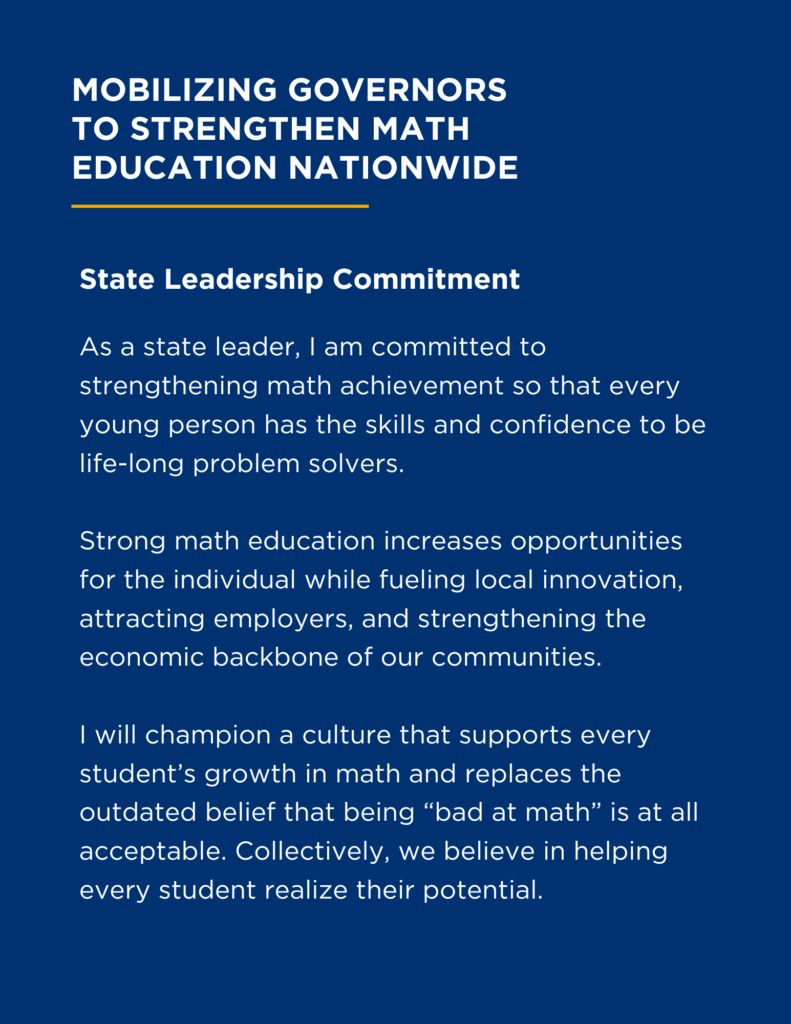
This commitment affirms that math achievement is foundational to your state’s long-term prosperity. It reinforces a simple but powerful idea: being “bad at math” is not inevitable, acceptable, or inconsequential. Every student can grow as a problem solver.
By signing the State Leadership Commitment, you affirm that:
- Math achievement is a statewide priority.
- A culture of numeracy matters as much as literacy.
- Students deserve access to strong instruction and opportunity.
- Your administration will champion policies that raise math outcomes.
This is a clear declaration of executive leadership to families, educators, employers, and future generations.
A National Call to Action
Mobilizing Public Health and Pediatric Leadership
Improving math achievement begins early — long before formal schooling.
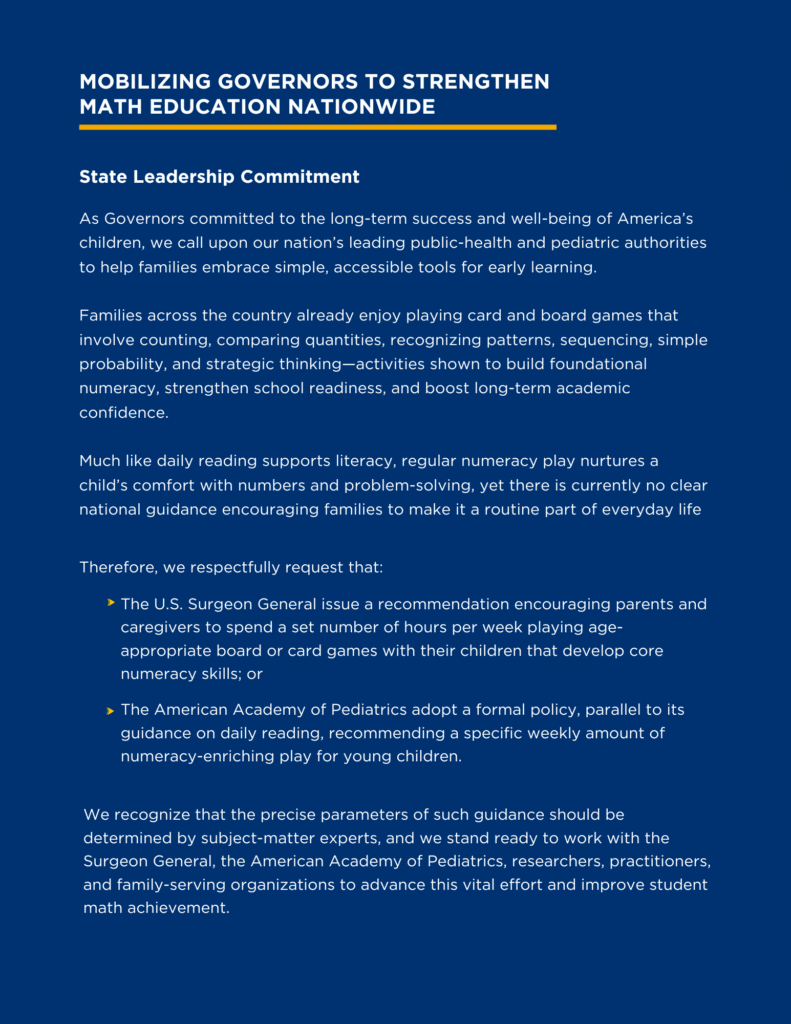
Governors are joining together to call on national public health and pediatric authorities to help families normalize numeracy-rich play in the early years. Just as pediatric guidance has helped institutionalize daily reading, similar guidance can elevate everyday math-building activities.
The letter respectfully requests that:
- The U.S. Surgeon General issue a recommendation encouraging regular numeracy-enriching play for young children; or
- The American Academy of Pediatrics adopt formal guidance recommending a weekly amount of age-appropriate numeracy play.
Board games, card games, and simple counting and comparison activities strengthen foundational math skills, build confidence, and improve long-term readiness.
This is not a mandate. It is a coordinated cultural intervention grounded in research and aligned with family life.
What States Can Do
Beyond culture-setting, state leaders can advance policies that raise student math achievement at scale.
We recommend six key strategies, backed by research and practice.
6 Strategies
Expand access to high-quality instructional materials.
Provide educators with high-quality professional learning aligned with classroom materials.
Increase instructional time before, during, and after the school day.
Automatically enroll students into advanced math courses when they’re ready.
Hold teacher preparation programs accountable for equipping teachers with the math skills, content, and mindsets needed to succeed.
Leverage math coaches to help teachers to improve classroom practice.
Suggested Social Posts for Governors and State Leaders
Explore two podcast episodes with local leaders in North Carolina and Texas, as well as national experts on math policy, to learn more about the impact auto enrollment is having on student outcomes – and why it should be adopted in states across the nation.
Culture + Early Numeracy
Workforce
NGA Meeting
Strong math skills are foundational to opportunity and economic growth in our state.
We are proud to join fellow governors in calling for a national push to support early numeracy through simple, everyday learning activities.
#WeAreAllSolvers
Math achievement fuels innovation, attracts employers, and strengthens our economic backbone.
We are committed to elevating math education and supporting families in building early numeracy skills.
At the National Governors Association Winter Meeting, we are focused on strengthening math education nationwide — because every student deserves the skills and confidence to be a lifelong problem solver.
#WeAreAllSolvers
Governors have the authority to set the signal.
By elevating math as a priority — culturally and policy-wise — states can ensure that every student develops the confidence and competence to solve the challenges ahead.
For partnership inquiries or to discuss activation strategies in your state, contact Adam Ezring at [email protected].