
We are seeing powerful momentum across the country as governors and state leaders affirm a shared belief that every child can be good at math – with efforts underway to open access to advanced classes, increase the use of high-quality classroom materials, strengthen supports for educators, and elevate math achievement as a national priority.
Governors Take Action
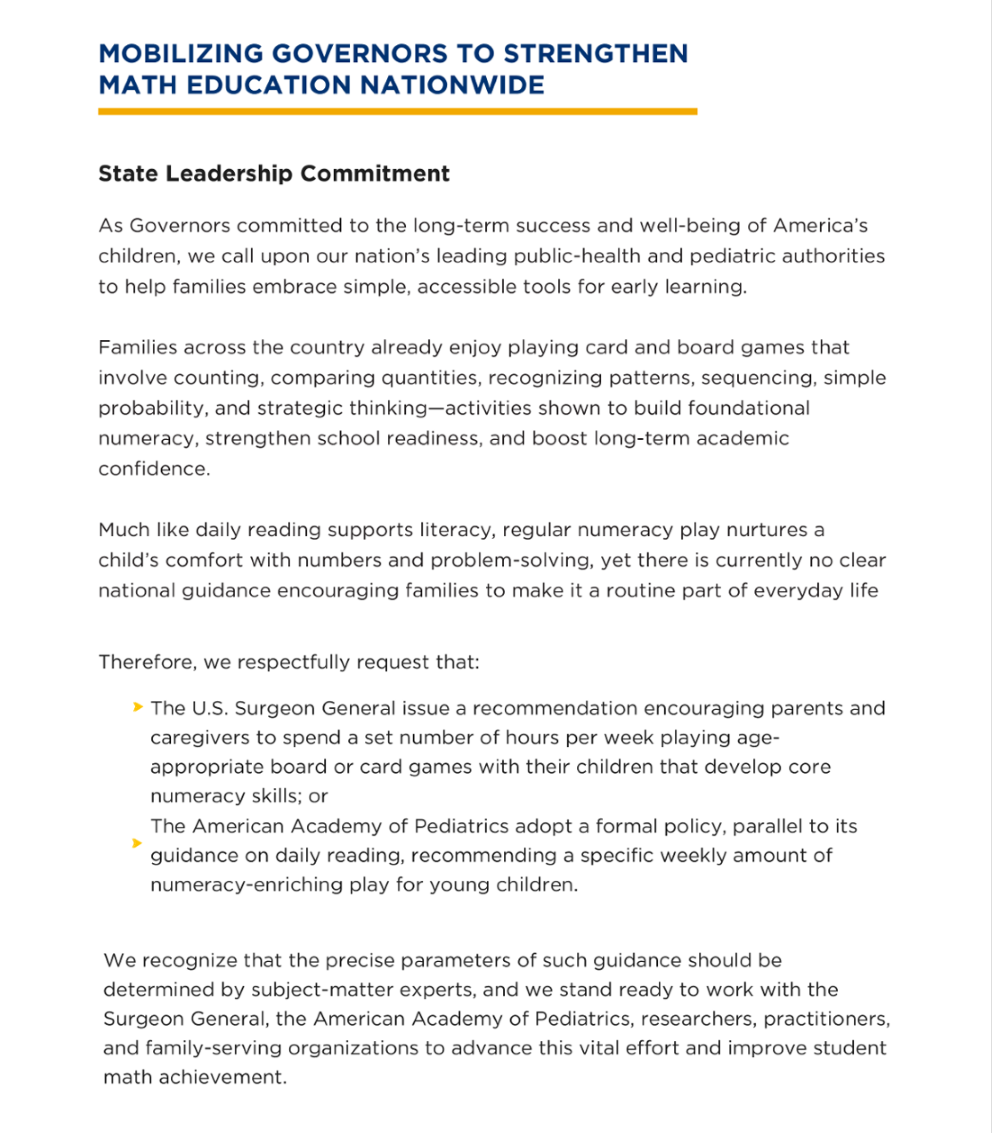

Across the country, governors are working to improve student outcomes in math and ensure every child has the foundational skills needed for long-term success. Research continues to show that early numeracy development plays a critical role in academic achievement, confidence, and future opportunity — and that learning can begin with simple, everyday activities at home.
Today, families already engage in games and activities that naturally build math skills: counting, recognizing patterns, comparing quantities, sequencing, strategic thinking, and understanding probability. Card games, board games, and other forms of numeracy-rich play can help children develop comfort with numbers long before they encounter more advanced math in the classroom.
Yet unlike literacy, where families are routinely encouraged to read with children every day, there is currently no widely recognized national guidance encouraging regular numeracy-focused play.
To help address this gap, governors from across the nation are joining together in a sign-on letter calling on the nation’s leading pediatric and public health organizations to promote simple, accessible math-building activities for families.
States Advancing Strong State Policy
ALABAMA
Alabama’s Numeracy Act (SB171), passed in 2022, created the Office of Mathematics Improvement to monitor the implementation of mathematics screener assessments, diagnostic assessments, and formative assessments for grades K-5. It also requires all K-2 students to be assessed using an early numeracy screener and grades 4-5 students must be assessed by a fractional reading screener at least two times a year. The legislation also allocates one mathematics coach for every public K-5 school with a student population of less than 800, and two coaches for a school with a student population of 800 or more.
ARKANSAS
In 2023, the Arkansas legislature passed a sweeping education reform bill known as the LEARNS Act, which includes a provision requiring each public school district and open enrollment charter school to develop a math intervention plan in the ‘23-’24 school year for students in grades 3-8 who do not perform at or above grade level on the state assessment. The legislation further requires districts to report in the ‘24-’25 school year the types of interventions being used and the number of students using them..
COLORADO
Colorado’s SB23, passed this year, requires the Department of Education, by January 2024, to offer free optional training in evidence-informed practices in mathematics, including training specifically designed for elementary school educators and secondary school mathematics educators. The bill also creates a grant program for interventions to help students who are below grade level or struggling in mathematics, children with disabilities, and students who are English learners.
FLORIDA
In May 2023, the Florida legislature passed a larger bill focused on literacy which includes a requirement for students in grades K-4 who show a “substantial deficiency in mathematics or dyscalculia” to receive support via intervention programs set out by the Department of Education and for parents to be notified of this support. It also requires districts to monitor these students’ performance and keep the parents updated and informed of performance progress.
LOUISIANA
In June 2023, the Louisiana legislature passed a bill that requires math teachers who teach grades 4-8 to take additional professional development related to numeracy; and requires districts to produce annual reports on the number of teachers who have successfully done so.
NORTH CAROLINA
Since the passage of HB 986 in 2018, North Carolina has had automatic enrollment in advanced math courses for all qualified students, elementary through high school. Legislation requires that all students who score a level five (the highest level) on their end-of-grade tests in math be automatically placed in an advanced math class the following year.
Since implementation and after a 2019 update requiring more annual reporting by region and subgroups, enrollment for advanced math courses has increased in all grade levels where the courses are offered, and evidence has shown meaningful increases in low-income and minority students taking advanced math courses. In the critical years of 8th through 11th grade, more than 95% of eligible students are now being enrolled in advanced math courses. Additionally, more middle schools are now offering high school level math courses. Not only are the percentage of eligible students increasing, but the pool of eligible students is increasing. In the last two years, the number of eligible students increased from 29k to 58k.
TEXAS
Texas passed legislation in 2023 (SB 2124) aimed at increasing the number of students in advanced mathematics courses in middle school and high school. The bill requires each school district and charter school to develop an advanced math program for middle school students such that the top 40% performers on the 5th grade math assessment exam be automatically enrolled in advanced math courses for 6th grade. This puts these advanced students on track to take Algebra 1 in their 8th-grade year, opening the door for them to take advanced classes such as calculus in high school. The parent may opt out of this automatic enrollment for their child.
VIRGINIA
In April 2022, Virginia passed legislation (HB938) requiring the state Board of Education to convene a group of stakeholders to provide feedback to the General Assembly on a number of key education goals, specifically including promoting excellence in math instruction. The report, released in the summer of 2023, called for enacting mathematics instruction reform that will prioritize the “science of math” approach to teaching mathematics in grades K-8, supporting the expansion of teacher professional learning opportunities to ensure high quality mathematics instruction is provided to all students. It also included recommendations to revise the state’s math standards, which now require the board to define “mastery” or proficiency for every grade level, that students have personalized mathematics pathways based on mastery and readiness, and that teachers determine the instructional sequence of the content that is best suited to meet the needs and goals of the student.
WEST VIRGINIA
In March 2023, the West Virginia legislature passed HB 3035, known as the Third Grade Success Act, aimed at developing a multi-tiered system of support for early literacy and numeracy in kindergarten through grade 3. Among the math provisions, the bill requires the development of an “appropriate list of literacy and numeracy screening tools, the creation of individualized reading or mathematics improvement plans for students identified as having a deficiency in grades K-4, and participation in comprehensive training on the science of reading and numeracy instruction.